 How
have enzymes evolved since life appeared on Earth? What has driven
the adaptation of enzyme catalysis to different temperatures?
Although massive work has been done, in 2017 these are still “hot”
questions searching for answers. An interesting paper by Nguyen et
al., just appeared on Science,
tackled this unsolved issue by investigating the molecular mechanisms
underlying thermoadaptation of enzyme catalysis through ancestral
sequence reconstruction spanning 3 billion years of evolution, and
using as a study-case the adenylate kinase (Adk). The authors assumed
as true the well-supported hot-start hypothesis, which implies that
life adapted to cooler temperatures because of the Earth’s cooling.
According to this, a thermophilic enzyme had to adapt to maintain a
high catalytic activity even at lower temperatures, while
accommodating relaxed selection on thermostability. It has been
hypothesized that enzymes overcame this thermal kinetic hurdle by
reducing the enthalpic activation barrier. However, Nguyen et
al., by reconstructing eight nodes of
the Adk lineage and expressing them together with four modern Adk
enzymes, found out something different. Indeed, from the analysis of
the Eyring plots, they showed that the oldest ancestors had a
strongly negative change in heat capacity of activation,
which can explain their extreme slow catalysis at low temperatures.
Conversely, along the thermoadaptation process toward cooler
temperatures, this kinetic obstacle has been progressively removed,
bringing the heat capacity of activation to zero. This close to zero heat capacity of activation was also observed for thermophilic enzymes evolved from mesophilic ancestors, but not for modern hyperthermophiles that remained thermophilic throughout their evolutionary pathway. This represents also a prove of the "evolutionary memory" of enzymes. To find out more about this new scenario, see here for the full manuscript.
How
have enzymes evolved since life appeared on Earth? What has driven
the adaptation of enzyme catalysis to different temperatures?
Although massive work has been done, in 2017 these are still “hot”
questions searching for answers. An interesting paper by Nguyen et
al., just appeared on Science,
tackled this unsolved issue by investigating the molecular mechanisms
underlying thermoadaptation of enzyme catalysis through ancestral
sequence reconstruction spanning 3 billion years of evolution, and
using as a study-case the adenylate kinase (Adk). The authors assumed
as true the well-supported hot-start hypothesis, which implies that
life adapted to cooler temperatures because of the Earth’s cooling.
According to this, a thermophilic enzyme had to adapt to maintain a
high catalytic activity even at lower temperatures, while
accommodating relaxed selection on thermostability. It has been
hypothesized that enzymes overcame this thermal kinetic hurdle by
reducing the enthalpic activation barrier. However, Nguyen et
al., by reconstructing eight nodes of
the Adk lineage and expressing them together with four modern Adk
enzymes, found out something different. Indeed, from the analysis of
the Eyring plots, they showed that the oldest ancestors had a
strongly negative change in heat capacity of activation,
which can explain their extreme slow catalysis at low temperatures.
Conversely, along the thermoadaptation process toward cooler
temperatures, this kinetic obstacle has been progressively removed,
bringing the heat capacity of activation to zero. This close to zero heat capacity of activation was also observed for thermophilic enzymes evolved from mesophilic ancestors, but not for modern hyperthermophiles that remained thermophilic throughout their evolutionary pathway. This represents also a prove of the "evolutionary memory" of enzymes. To find out more about this new scenario, see here for the full manuscript.
Showing posts with label Evolution. Show all posts
Showing posts with label Evolution. Show all posts
Monday, January 30, 2017
Evolution and Thermoadaptation in Enzymes
How
have enzymes evolved since life appeared on Earth? What has driven
the adaptation of enzyme catalysis to different temperatures?
Although massive work has been done, in 2017 these are still “hot”
questions searching for answers. An interesting paper by Nguyen et
al., just appeared on Science,
tackled this unsolved issue by investigating the molecular mechanisms
underlying thermoadaptation of enzyme catalysis through ancestral
sequence reconstruction spanning 3 billion years of evolution, and
using as a study-case the adenylate kinase (Adk). The authors assumed
as true the well-supported hot-start hypothesis, which implies that
life adapted to cooler temperatures because of the Earth’s cooling.
According to this, a thermophilic enzyme had to adapt to maintain a
high catalytic activity even at lower temperatures, while
accommodating relaxed selection on thermostability. It has been
hypothesized that enzymes overcame this thermal kinetic hurdle by
reducing the enthalpic activation barrier. However, Nguyen et
al., by reconstructing eight nodes of
the Adk lineage and expressing them together with four modern Adk
enzymes, found out something different. Indeed, from the analysis of
the Eyring plots, they showed that the oldest ancestors had a
strongly negative change in heat capacity of activation,
which can explain their extreme slow catalysis at low temperatures.
Conversely, along the thermoadaptation process toward cooler
temperatures, this kinetic obstacle has been progressively removed,
bringing the heat capacity of activation to zero. This close to zero heat capacity of activation was also observed for thermophilic enzymes evolved from mesophilic ancestors, but not for modern hyperthermophiles that remained thermophilic throughout their evolutionary pathway. This represents also a prove of the "evolutionary memory" of enzymes. To find out more about this new scenario, see here for the full manuscript. 
Wednesday, May 25, 2016
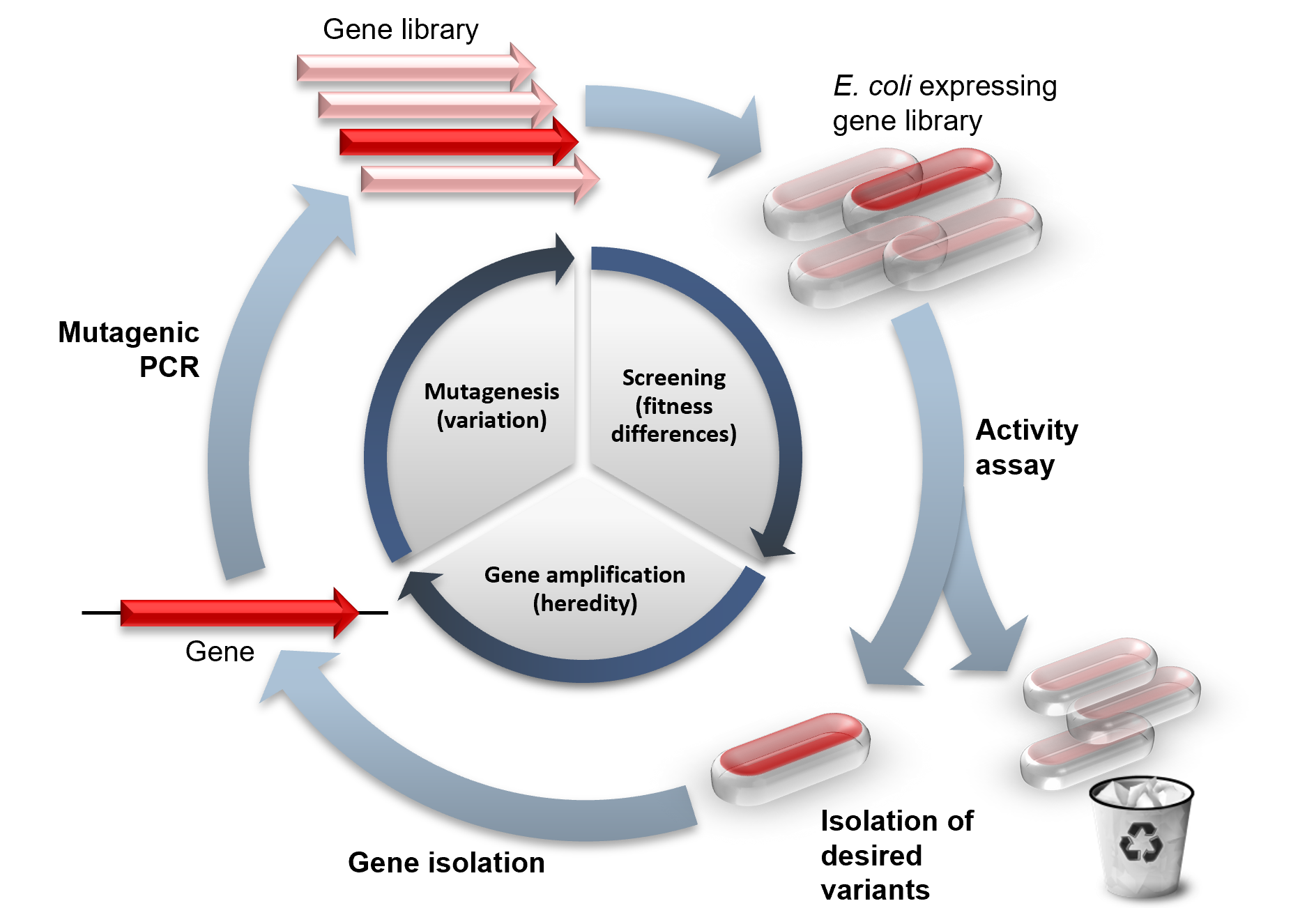
Millennium Technology Prize for Direct Evolution
This year the Millennium Technology Prize was received by Frances Arnold for the development of the direct evolution technique, an approach that allows to evolve in vitro enzymes mimicking the process of natural evolution, and select mutants with desired properties. Read here the details of the prize. This is a great news. I am not an expert of the field but along the years I enjoyed the work of F. Arnold focusing on the design of thermostable enzymes. Too many articles to refer to, so it is easier to get a look here at the long publication list of the author.
Friday, May 20, 2016
Temperature spectrum of life
I have recently received communication of a new manuscript appeared in PLOS One, "The Biokinetic Spectrum for Temperature" by R. Corkrey and coworkers at the Univ. of Tasmania [see here]. The authors reconstructed the spectrum of temperatures where living organisms thrive, better, and more precisely, the authors reconstructed the distribution of temperature-dependent specific growth rate for life on Earth. The distribution shows a first peak centred at about 40 °C followed by a second one at higher temperature, 67 °C. Between the two peaks, a gap mirroring the separation between mesophilic and thermophilic species. The authors relate the biokinetic spectrum to the thermal stability of the underlying molecular machinery (proteins) sustaining the organisms metabolism. This is an intriguing contribution to understand the relationship among protein evolution and life adaptation in different thermodynamic environment. Enjoy it.


Subscribe to:
Posts (Atom)