 How
have enzymes evolved since life appeared on Earth? What has driven
the adaptation of enzyme catalysis to different temperatures?
Although massive work has been done, in 2017 these are still “hot”
questions searching for answers. An interesting paper by Nguyen et
al., just appeared on Science,
tackled this unsolved issue by investigating the molecular mechanisms
underlying thermoadaptation of enzyme catalysis through ancestral
sequence reconstruction spanning 3 billion years of evolution, and
using as a study-case the adenylate kinase (Adk). The authors assumed
as true the well-supported hot-start hypothesis, which implies that
life adapted to cooler temperatures because of the Earth’s cooling.
According to this, a thermophilic enzyme had to adapt to maintain a
high catalytic activity even at lower temperatures, while
accommodating relaxed selection on thermostability. It has been
hypothesized that enzymes overcame this thermal kinetic hurdle by
reducing the enthalpic activation barrier. However, Nguyen et
al., by reconstructing eight nodes of
the Adk lineage and expressing them together with four modern Adk
enzymes, found out something different. Indeed, from the analysis of
the Eyring plots, they showed that the oldest ancestors had a
strongly negative change in heat capacity of activation,
which can explain their extreme slow catalysis at low temperatures.
Conversely, along the thermoadaptation process toward cooler
temperatures, this kinetic obstacle has been progressively removed,
bringing the heat capacity of activation to zero. This close to zero heat capacity of activation was also observed for thermophilic enzymes evolved from mesophilic ancestors, but not for modern hyperthermophiles that remained thermophilic throughout their evolutionary pathway. This represents also a prove of the "evolutionary memory" of enzymes. To find out more about this new scenario, see here for the full manuscript.
How
have enzymes evolved since life appeared on Earth? What has driven
the adaptation of enzyme catalysis to different temperatures?
Although massive work has been done, in 2017 these are still “hot”
questions searching for answers. An interesting paper by Nguyen et
al., just appeared on Science,
tackled this unsolved issue by investigating the molecular mechanisms
underlying thermoadaptation of enzyme catalysis through ancestral
sequence reconstruction spanning 3 billion years of evolution, and
using as a study-case the adenylate kinase (Adk). The authors assumed
as true the well-supported hot-start hypothesis, which implies that
life adapted to cooler temperatures because of the Earth’s cooling.
According to this, a thermophilic enzyme had to adapt to maintain a
high catalytic activity even at lower temperatures, while
accommodating relaxed selection on thermostability. It has been
hypothesized that enzymes overcame this thermal kinetic hurdle by
reducing the enthalpic activation barrier. However, Nguyen et
al., by reconstructing eight nodes of
the Adk lineage and expressing them together with four modern Adk
enzymes, found out something different. Indeed, from the analysis of
the Eyring plots, they showed that the oldest ancestors had a
strongly negative change in heat capacity of activation,
which can explain their extreme slow catalysis at low temperatures.
Conversely, along the thermoadaptation process toward cooler
temperatures, this kinetic obstacle has been progressively removed,
bringing the heat capacity of activation to zero. This close to zero heat capacity of activation was also observed for thermophilic enzymes evolved from mesophilic ancestors, but not for modern hyperthermophiles that remained thermophilic throughout their evolutionary pathway. This represents also a prove of the "evolutionary memory" of enzymes. To find out more about this new scenario, see here for the full manuscript.
Showing posts with label Thermodynamic stability. Show all posts
Showing posts with label Thermodynamic stability. Show all posts
Monday, January 30, 2017
Evolution and Thermoadaptation in Enzymes
How
have enzymes evolved since life appeared on Earth? What has driven
the adaptation of enzyme catalysis to different temperatures?
Although massive work has been done, in 2017 these are still “hot”
questions searching for answers. An interesting paper by Nguyen et
al., just appeared on Science,
tackled this unsolved issue by investigating the molecular mechanisms
underlying thermoadaptation of enzyme catalysis through ancestral
sequence reconstruction spanning 3 billion years of evolution, and
using as a study-case the adenylate kinase (Adk). The authors assumed
as true the well-supported hot-start hypothesis, which implies that
life adapted to cooler temperatures because of the Earth’s cooling.
According to this, a thermophilic enzyme had to adapt to maintain a
high catalytic activity even at lower temperatures, while
accommodating relaxed selection on thermostability. It has been
hypothesized that enzymes overcame this thermal kinetic hurdle by
reducing the enthalpic activation barrier. However, Nguyen et
al., by reconstructing eight nodes of
the Adk lineage and expressing them together with four modern Adk
enzymes, found out something different. Indeed, from the analysis of
the Eyring plots, they showed that the oldest ancestors had a
strongly negative change in heat capacity of activation,
which can explain their extreme slow catalysis at low temperatures.
Conversely, along the thermoadaptation process toward cooler
temperatures, this kinetic obstacle has been progressively removed,
bringing the heat capacity of activation to zero. This close to zero heat capacity of activation was also observed for thermophilic enzymes evolved from mesophilic ancestors, but not for modern hyperthermophiles that remained thermophilic throughout their evolutionary pathway. This represents also a prove of the "evolutionary memory" of enzymes. To find out more about this new scenario, see here for the full manuscript. 
Friday, May 20, 2016
Temperature spectrum of life
I have recently received communication of a new manuscript appeared in PLOS One, "The Biokinetic Spectrum for Temperature" by R. Corkrey and coworkers at the Univ. of Tasmania [see here]. The authors reconstructed the spectrum of temperatures where living organisms thrive, better, and more precisely, the authors reconstructed the distribution of temperature-dependent specific growth rate for life on Earth. The distribution shows a first peak centred at about 40 °C followed by a second one at higher temperature, 67 °C. Between the two peaks, a gap mirroring the separation between mesophilic and thermophilic species. The authors relate the biokinetic spectrum to the thermal stability of the underlying molecular machinery (proteins) sustaining the organisms metabolism. This is an intriguing contribution to understand the relationship among protein evolution and life adaptation in different thermodynamic environment. Enjoy it.


Tuesday, November 17, 2015
Over 100°C
 What factors contribute to protein stability at very extreme temperatures? What gain comes from entropy and enthalpy? And how to account for the delicate effect of temperature on molecular interactions like the hydrophobic and ionic ones? All this is tackled in a very intriguing work by Y. Matsura et al. "Thermodynamics of protein denaturation at temperature over 100°C: CutA1 mutant proteins substituted with hydrophobic and charged residues" recently published in Scientific Reports [see here]. By designing sequential mutations the authors were able to construct hyper-stable versions of the CutA1 protein and to extract the main thermodynamic parameters characterising their thermal stability. It is a very important work challenging both technical biochemical problems, like the aggregation of proteins generally occurring above 80°C, and the basic thermodynamics controlling protein stability over 100°C where for instance hydrophobic interactions cease to be entropically driven and ion-pairing can benefit from water dielectric constant decrease.
 Tuesday, May 5, 2015
And yet it functions!
A nice paper adressing the issue of how mesophilic/thermophilic enzymes
functions at differents temperatures is just out in Biochemistry [see
here].
The work by the group of EA Eisenmesser focuses on the behavior of the
cyclophilin enzyme from Geobacillus kaustophililus (GeoCyp), a bacterium
found in the the deep see sediment of the Mariana Trench, and compared
to its mesophilic homologous from humans (CypA). The study demonstrates
that, at variance with other mesophilic/thermophilic pair, here, the
thermophile maintains up to 70% of its catalytic power at low
temperature where most of thermophiles do not function or have very
limited activity. We have already posted on the "corresponding state
principle", introduced to explain why most of thermophiles lack activity
at ambient conditions. According to this view, the lack of activity is
due to the enhanced rigidity of the protein matrix which compromises
mobility essential to the catalytic turn-over. At the same time
mechanical rigidity is postulated as the source of the enhanced
stability of the protein and its resistance to thermal stress. The
universality of this principle has been questioned by showing that in
many cases thermophiles can be as flexible as their mesophilic variants
at the same thermodynamic conditions, thus stability is the results of a
smaller entropy penalty between folded (less entropic) and unfolded
(more entropic) states.
According to the work by Eisenmesser and coworkers, the thermophilic
GeoCyp is highly similar from the structural point of view to the human
CypA, and its dynamics at different timescales is comparable even if its
mobility seems more sensitive to temperature increases. What probably
causes the 30% drop of activity at low temperature (10°C) with respect
to activity at its optimal temperature (60°C) is a reduced local motion
of binding-site loop, which gating is affected by the presence of a
charged amino-acid, and a slightly less strong electric field measured
at the level of the catalytic site and supposed to ease the
isomerization of the peptide bond. In summary, this study shows us
another deviation from the common believe based on the observation of
reduced thermophilic activity at low temperatures. Nice work!
Tuesday, March 3, 2015
Protein Design
Extremophilic proteins represent a natural template to understand how enzymatic activity can be performed in non conventional conditions, i.e. high temperature, high salt concentration, low temperature, high pressure. Evolution has driven this migration of protein sequences/folds toward optimal states for different environments. How 'artificial evolution' can do the same job? In other words, how protein design can succeed in mutating proteins for changing their working milieu, or even incorporate new chemical activity? I propose to the readers two interesting reviews on this subject. One is from J.G. Saven group [1], the other from D. Baker and K.N Houk [2]. It is amazing how leading groups in the field have advanced the research combining multiple approaches. Enjoy!
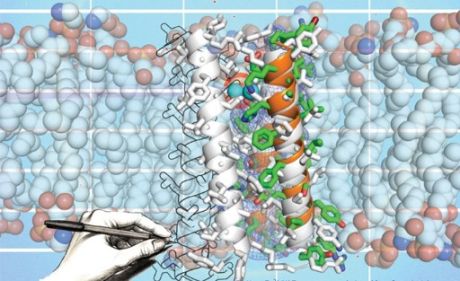
[1] I. Samish, C.M. MacDermaid, J.M. Perez-Aguilar, J.G. Saven, Ann.Rev.Phys.Chem. (2011) 62, 129-149. (here)
[2] G. Kiss, N. Celebi-Olcum, R. Moretti, D. Baker, and K.N. Houk, Angew. Chem. Int. Ed. (2013) 52, 5700-5725. (here)
Tuesday, October 21, 2014
Stay wet, stay stable?
Proteins often host water molecules inside buried cavities or superficial clefts. The presence of these molecules was first resolved via x-ray crystallography and their exchanging dynamics with the external solution was deeply investigated by NMR experiments, the interested readers can dig all the work done by B. Halle and collaborators, see the Halle's web page. Molecular Dynamics simulations also shed light on the molecular mechanisms of this exchange, earlier work by Hummer and Garcia [1] and Sterpone, Ceccarelli and Marchi [2], date back to 2000 or so. It was always questioned the contribution of this set of molecules to the stability of the protein fold. Very recently we decided to tackle the problem and relate it to the issue of protein thermal stability [3]. The starting question was: is the extra stability of a thermophilic protein correlated to its internal hydration. For our study case, the pair of homologous G-domain from the mesophilic E. coli and the hyperthermophilic S. solfataricus, the answer is yes, at least a bit. The manuscript is here.

[1] G. Hummer and A.E. Garcia "Water Penetration and Escape in Proteins". Proteins 2000, 38, 261−272.
[2] F. Sterpone, M. Ceccarelli, M. Marchi, "Dynamics of Hydration in Hen Egg White Lysozyme. J. Mol. Biol. 2001, 311, 409−419.
[3] O. Rahaman, M. Kalimeri, S. Melchionna, J. Henin, F. Sterpone "Role of Internal Water on Protein Thermal Stability: The Case of Homologous G Domains ", J. Phys. Chem. B 2014 in press.
Friday, October 3, 2014
Coarse-graining can track protein thermal stability?
Molecular simulation based on coarse-grained (CG) models is commonly used to explore large scale molecular motion or folding/unfolding processes. However, it is questionable wether these simplified models are good enough to capture the different thermal-stabilities of proteins.
Here several problems come upfront. Not all CG models are apt to monitor protein unfolding and stability. In some cases external biases are glued on top of the model in order to ensure proteins stability during a simulation; without these biases the structures just do not hold. As consequence the effect of physical/chemical perturbations to the folded structure cannot be appreciated. In other models, the folded state is encoded in native-biases -as in the Go-like model- so one wonder wether the detected unfolding paths that are key to distinguish the stabilities of homologues are "real". Finally, one should always keep in mind that a CG hamiltonian is made up of effective interactions, and, if a rigorous bottom-up graining approach is used, this implies that the model is temperature and concentration and pressure dependent. That is, the thermodynamic reference state is embedded in the interactions. This makes troubles when simulations are performed at different temperatures as in the case of the Replica Exchange Method. Despite the limitations, the possibility to use a CG model to explore the kinetic and thermodynamic stabilities of mesophilic and thermophilic proteins is rather appealing. We have tackled the problem recently, and nice results have been obtained. The paper is out here. If you have not access, just ask!

Tuesday, September 30, 2014
Tracking the corresponding state principle
Maria KALIMERI just graduated from Univ Paris VII. Congratulations! Her thesis focused on mechanical properties of thermophilic proteins explored via an innovative framework based on network analysis. Here a bite of her work "Understanding the relation between protein flexibility, stability and function remains one of the most challenging, open questions in biophysical chemistry. For example, proteins need to be flexible to facilitate substrate binding but locally rigid to sustain substrate specificity. Exemplary cases are enzymes from microorganisms that thrive at elevated temperatures, also referred to as thermophiles. These proteins are stable and functional at the high temperature regime but generally lack activity at ambient conditions. Therefore, their thermal stability has been correlated to enhanced mechanical rigidity through the corresponding states paradigm. The generality of this view, however, has been questioned by a number of
experimental and computational studies. In the present study, we employ the gold standard of computational techniques, namely Molecular Dynamics simulations, in order to identify microscopical characteristics that distinguish thermophilic from mesophilic proteins, elaborating in particular on the rigidity paradigm mentioned above." For a more complete reading see here.

Yellowstone Thermophiles
Beautiful pictures. I found an interesting web-site dedicated to thermophilic life in the Yellowstone National Park (US), see here. I quote from the home page "There is so much to know and so much to find out about the extreamophiles in Yellowstone National Park. Since the discovery of Thermus aquaticus in 1969 a universe of interest has surrounded the life forms that survive - even thrive at very high temperatures. At the time that Thomas C. Brock and Hudson Freeze reported the new life form, it was thought that only a few organisms could survive at high temperatures above about 130F. Since its discovery, interest has spread and much has been learned. The scientific community has devoured the subject with relish. Only recently has this knowledge crept into the popular mind. As people learn of the extreme conditions of life at 175F they want to know more. It's fascinating and awe inspiring. It is a concept that is wondrous to contemplate. Questions are asked: "What do they eat?" - "How big are they?" - "Where are they?" - "How do they do it?" - "What do they look like?" The answers are as fascinating as the organisms. I would like to help answer the last question above. As I travel in Yellowstone I am drawn to their colors and patterns and diverse images that they etch on my eye. I take some snapshots and present a few of them here." Enjoy the Gallery!

Saturday, March 22, 2014
Towards new thermostable proteins
ResearchMedia just published an highlight of the project THERMOS. The article "Towards new thermostable proteins" is in the new issue of the magazine International Innovation and can be read here (courtesy of RM). The article presents a nice overview of the project, a short description of what done so far and more importantly the lines of research we are following. Enjoy it!

Sunday, December 29, 2013
Thermodynamically speaking
In the context of reversible unfolding, protein stability is defined as the difference between the free energies of the unfolded and folded states, ΔG. That is, as long as we can safely talk about a ‘two state’ unfolding process.
So the greater this difference, the more stable the protein.

Although it is easy to derive the formula that gives ΔG with respect to temperature (see the curve in the figure below) it is much harder, and not always possible, to experimentally determine the two parameters of the formula that differ for different proteins and determine the exact shape of the curve (for an enlightening discussion on thermodynamic stability see the relevant section of this review or the original work of Nojima et al.).

Typical stability curve of a protein (G. Feller, J. Phys.: Condens. Matter, 2010)
Now, the entropy of protein folding in general has two major opposite contributions: the favorable hydrophobic effect and the unfavorable loss of conformational entropy that comes with the protein collapse. Thus when thermophiles have to compensate a smaller entropic penalty, they either have a rather compact or structured denatured state that already isolates the hydrophobic groups from the water or … a more flexible folded state. Or both.
Subscribe to:
Posts (Atom)