A few months ago we published an explorative work focusing on the possible contribution of water molecules buried in the interior of proteins to their different thermal stabilities [see here for the paper]. The study-case was a pair of homologous GTPase domains from a mesophilic and a hyperthermophilic organism, respectively. Now, we extended our approach by considering a large set of homologous pairs. Let's list the main findings. Firstly, for some homologues internal water gives a meaningful contribution to the stability gap in favour of the thermophilic variant. This was probed at ambient condition. Secondly, when considering the behaviour at high temperature, we found that thermophilic proteins are more keen to maintain their internal cavities wet, and therefore benefiting by this wetting. We propose that internal hydration can be viewed as an alternative tuneable variable for the engineering of proteins with enhanced stability. Enjoy the manuscript here.
Showing posts with label Free energy. Show all posts
Sunday, November 1, 2015
Monday, May 18, 2015
Designing thermal stability via non-equilibrium simulations
The design of protein thermal stability is appealing for practical uses.
In a recent work [1] by Tian, Woodard, Whitney and Shakhnovich [see here] non-equilibrium Monte Carlo simulations were
effectively used to explore mutations of the Dihydrofolate Reductase
(DHFR) and their impact on both the stability and functionality of the
enzyme.
The key point of the work is the use of non-equilibrium Monte Carlo (MC) simulations. A protein is excited at different temperatures and its
"unfolding " as function of MC steps is recorded.
For each temperature, the average value of a given observable or order
parameter that describes the state of the protein, ie the root mean
square displacement with respect to the native state, the energy, the
gyration radius, depends on the simulation length -in the specific case
the number of MC steps. This relates to the fact that the transition
from the folded to the unfolded state, for a given temperature, is rate
limited by the free energy barrier dividing the two states. How this
dependence can be washed up when considering the effect of mutations?
The authors proved a nice recipe: first, a mutation affects the
thermodynamics of the system, formally the free energy difference
between folded and unfolded state, but also the kinetics for the
folded/unfolded transition, aka the free energy barrier dividing the two
state. It is possible to image that the thermodynamic effect is
mirrored on the change of free energy barrier via a scaling factor that measures
how the mutation influences the transition state of the folding/unfolding process.
Secondly, when considering the non-equilibrium MC simulations for both the
wild type and the mutant, the shift of the apparent melting temperature
(the temperature leading unfolding) of the mutated system with respect
to WT results independent from the simulation length. This can be formally showed, and the reader is invited to dig the work.
Using this strategy several mutations stabilizing the protein and that
maintain functionality were identified. I wonder whether this approach
can be used straightforwardly also for estimating the effect of
mutations on mechanical stability.
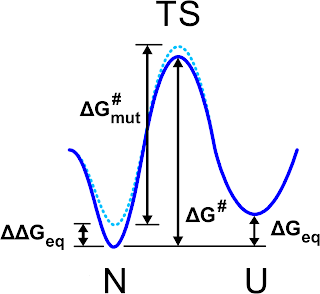
| Schematic view of the free energy profile for the folded (N) unfolded (U) states as it is pictured in Fig. 1 of Ref. 1 |
[1] J. Tian, JC Woodard, A. Whitney, EI Shakhnovich, Plos Comp Bio (2015) 11, e1004207.
Tuesday, October 21, 2014
Stay wet, stay stable?
Proteins often host water molecules inside buried cavities or superficial clefts. The presence of these molecules was first resolved via x-ray crystallography and their exchanging dynamics with the external solution was deeply investigated by NMR experiments, the interested readers can dig all the work done by B. Halle and collaborators, see the Halle's web page. Molecular Dynamics simulations also shed light on the molecular mechanisms of this exchange, earlier work by Hummer and Garcia [1] and Sterpone, Ceccarelli and Marchi [2], date back to 2000 or so. It was always questioned the contribution of this set of molecules to the stability of the protein fold. Very recently we decided to tackle the problem and relate it to the issue of protein thermal stability [3]. The starting question was: is the extra stability of a thermophilic protein correlated to its internal hydration. For our study case, the pair of homologous G-domain from the mesophilic E. coli and the hyperthermophilic S. solfataricus, the answer is yes, at least a bit. The manuscript is here.
[1] G. Hummer and A.E. Garcia "Water Penetration and Escape in Proteins". Proteins 2000, 38, 261−272.
[2] F. Sterpone, M. Ceccarelli, M. Marchi, "Dynamics of Hydration in Hen Egg White Lysozyme. J. Mol. Biol. 2001, 311, 409−419.
[3] O. Rahaman, M. Kalimeri, S. Melchionna, J. Henin, F. Sterpone "Role of Internal Water on Protein Thermal Stability: The Case of Homologous G Domains ", J. Phys. Chem. B 2014 in press.
Subscribe to:
Posts (Atom)

